Are patient sign-in sheets a HIPAA violation?
 By David Freeland3 min read ·
The name three lines up
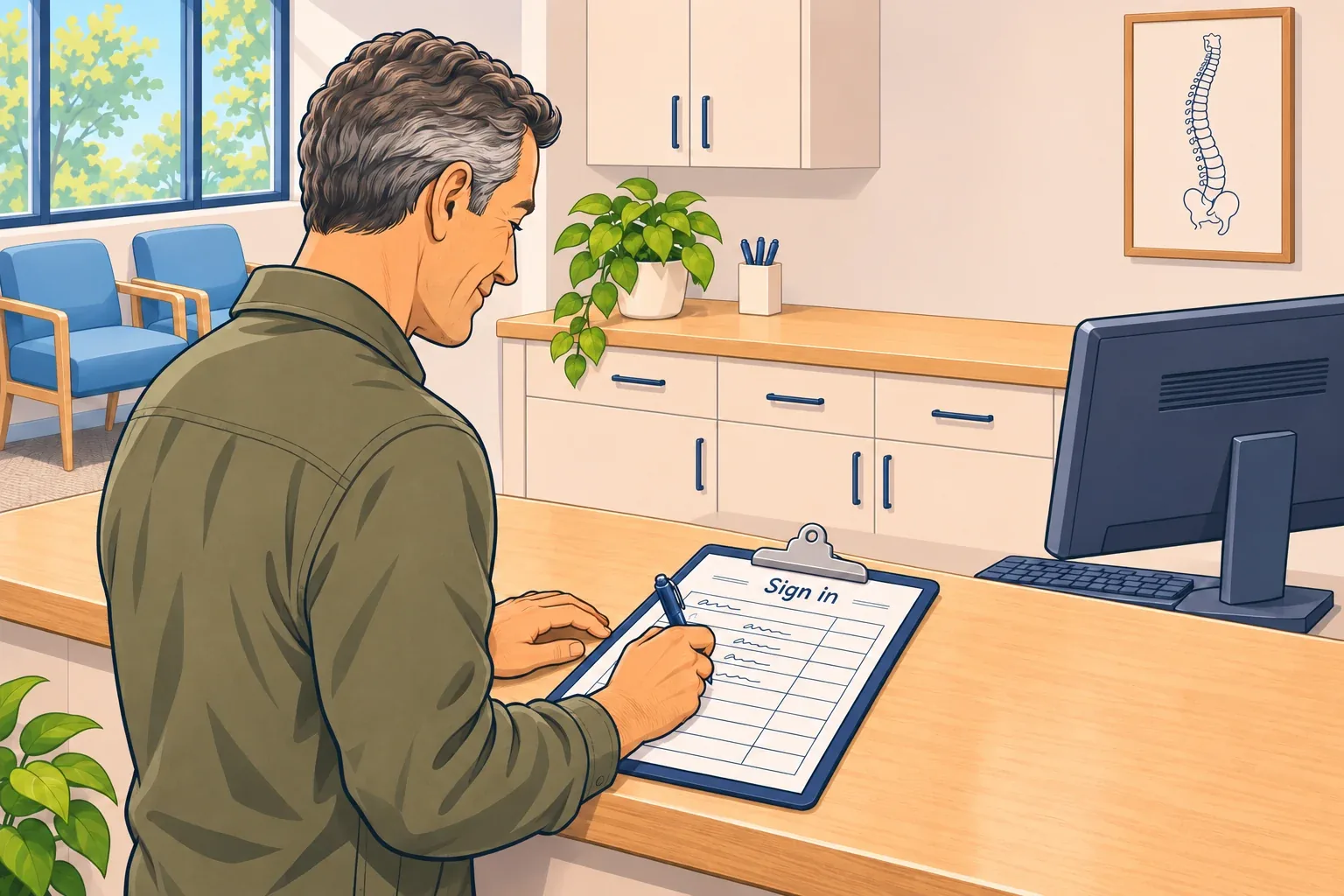
It’s Wednesday evening, and the after-work patients are coming in. One of them picks up the pen at the sign-in clipboard. Three lines up, she sees her neighbor’s name. Beside it, in the column marked “Reason for visit,” her neighbor wrote “neck pain, car accident.”
She doesn’t mean any harm. The next morning, she waves to her neighbor across the driveway. “I didn’t know we go to the same chiropractor! I hope your neck is feeling better.” Her neighbor didn’t tell her about the accident. The sign-in sheet did.
The clipboard worked the way it was set up to work. The trouble was the column that asked why.
What a sign-in sheet tells the next person in line
Think of the waitlist clipboard at a busy restaurant. Everyone who walks up can read the names above their own. At a restaurant, that list tells you who’s waiting for a table. At your clinic, the same kind of list tells people who your patients are.
That’s why the names count as protected health information (PHI). HHS says a name becomes PHI once it’s tied to someone’s care, like showing they’re a patient at a clinic. Add a reason for the visit, and the sheet shares why each person came in, too.
HIPAA doesn’t expect your waiting room to be sealed off. HHS says the rule doesn’t require removing every risk. Some things get seen or heard in passing, like a name called across the room. HHS calls these incidental disclosures. They’re limited, hard to avoid, and a side effect of everyday work. They’re allowed only when your clinic has done its part to keep them small.
What HIPAA says about sign-in sheets
HHS answers this in a short FAQ. Practices may use sign-in sheets and call patients by name in the waiting room. The Privacy Rule “explicitly permits the incidental disclosures that may result from this practice,” like another patient reading the names above hers.
There’s a condition. Those glimpses are allowed only when the practice uses reasonable safeguards and limits the information to what’s needed. HHS gives one example of what doesn’t belong: medical details that aren’t needed to sign in, such as the problem the patient is there for. The same goes for calling names out loud. When you call someone back, a best practice is to use only a first name, or a first name and last initial, rather than a full name.
The rule behind the FAQ is 45 CFR 164.502(a)(1)(iii). It allows incidental disclosures only when a practice also meets two other standards. One is the minimum necessary standard (164.502(b)), which means sharing no more than the task needs. The other is safeguards (164.530(c)), which means reasonable steps to protect patient information. HHS’s guidance puts the stakes plainly. A disclosure that happens because a practice skipped those steps “is not permitted under the Privacy Rule.”
The sheet is still PHI after the last patient signs in. HHS says practices can’t abandon PHI or toss it in a dumpster. For paper, its examples are shredding, burning, pulping, or pulverizing, so no one can read it. HIPAA doesn’t require one method.
Three changes for your sign-in sheet
- Ask only for what check-in needs. A name and an arrival time are usually enough. Leave off why they’re visiting, their symptoms, and anything else medical. If the front desk needs more, ask for it at the counter.
- Keep earlier names out of sight. Peel-off label sheets, a cover sheet that slides down the page, or a check-in tablet make it harder for the next person to read the list. Keep the sheet where the front desk can see it.
- Shred it, and ask about the screen. Store finished sheets where patients can’t see them. When it’s time to get rid of one, shred it instead of throwing it away. If patients check in on a tablet or kiosk, the names are electronic PHI, so the HIPAA Security Rule applies too. Ask your IT company to check that it clears between patients.
A few small changes let your sign-in sheet do its one job and nothing more.
General information, not legal advice.
Last reviewed November 19, 2026.
References & statutory citations
- U.S. Department of Health and Human Services, Office for Civil Rights: Guidance Regarding Methods for De-identification of Protected Health Information in Accordance with the Health Insurance Portability and Accountability Act (HIPAA) Privacy Rule (guidance page; undated; viewed November 19, 2026). (opens in a new tab)
- U.S. Department of Health and Human Services, Office for Civil Rights: Incidental Uses and Disclosures (guidance page; content last reviewed July 26, 2013). (opens in a new tab)
- U.S. Department of Health and Human Services, Office for Civil Rights: May physician’s offices use patient sign-in sheets or call out the names of their patients in their waiting rooms? (HIPAA FAQ; created December 19, 2002; last updated March 14, 2006; content last reviewed December 28, 2022). (opens in a new tab)
- Electronic Code of Federal Regulations: 45 CFR 164.502(a)(1)(iii) and (b), Uses and disclosures of protected health information: General rules (up to date as of October 23, 2026). (opens in a new tab)
- Electronic Code of Federal Regulations: 45 CFR 164.530(c), Administrative requirements: Safeguards (up to date as of October 22, 2026). (opens in a new tab)
- U.S. Department of Health and Human Services, Office for Civil Rights: What do the HIPAA Privacy and Security Rules require of covered entities when they dispose of protected health information? (HIPAA FAQ 575; created February 18, 2009; content last reviewed November 6, 2015). (opens in a new tab)
- U.S. Department of Health and Human Services, Office for Civil Rights: Summary of the HIPAA Security Rule (content last reviewed August 7, 2026). (opens in a new tab)